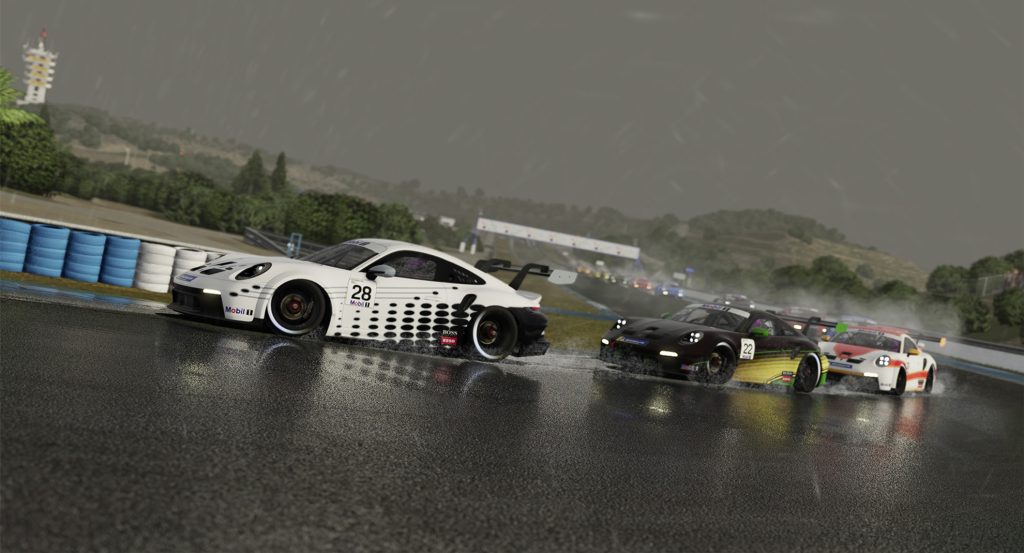
Our world has developed exponentially over the past 15 years. Graphics and physics have now reached a point where the boundaries are blurring. But one question persists, often asked by outsiders: "Is this really sport, or are you just gaming?"
At SimUltimate, we have a clear stance on this, one that is supported by the reality of modern motorsport: Whoever sits in a simulator today is not playing. They are training.
It is no coincidence that world champions like Max Verstappen or talents such as Lando Norris and Raffaele Marciello spend hours in iRacing or Assetto Corsa Competizione. They do not do this to pass the time. They use the simulator to sharpen their senses and automate cognitive processes. But how exactly does this transfer from the virtual to the real world work? The answer lies in human perception.
In a real race car, physical forces bombard five senses simultaneously. In the simulator, in most cases, we lack G‑forces, the smell of gasoline, and physical fear. This means: a sim racer must train the remaining senses (seeing, hearing, feeling) to an extremely higher level in order to compensate for the missing information.
Let us take a detailed look at this sensory work.
© SRO
Haptics
The sense of touch is your most important connection to the physics of the car in the simulator. In real life, you feel deceleration under braking with your entire body; your head nods forward, the belt tightens. In the simulator, this feedback is completely absent. This is where a fascinating neurological reprogramming takes place.
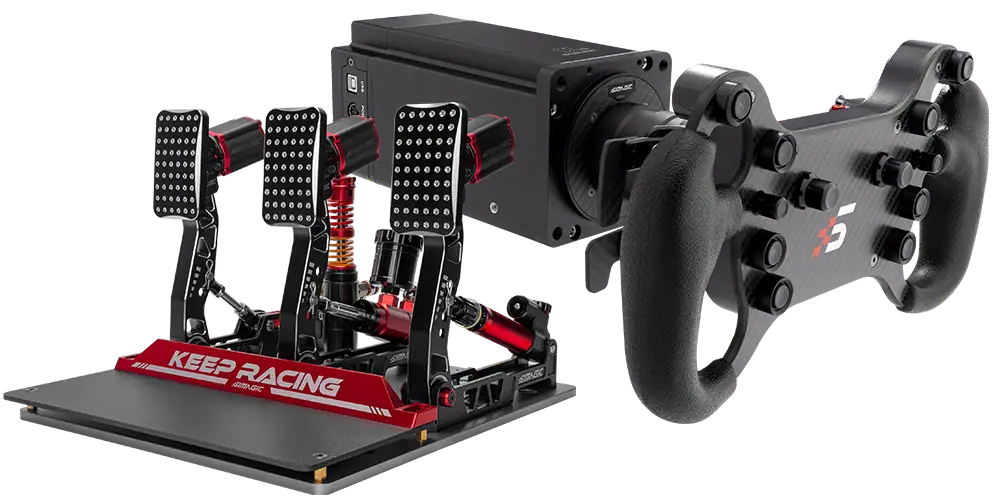
You must learn to control brake pressure purely through muscle memory in your leg. This is why we repeatedly talk about load cell brake pedals. It is not about gimmicks, but about teaching your brain to apply 80 kilograms of pressure blindly and consistently, without your body receiving feedback from deceleration. Developing this fine motor control is pure training.
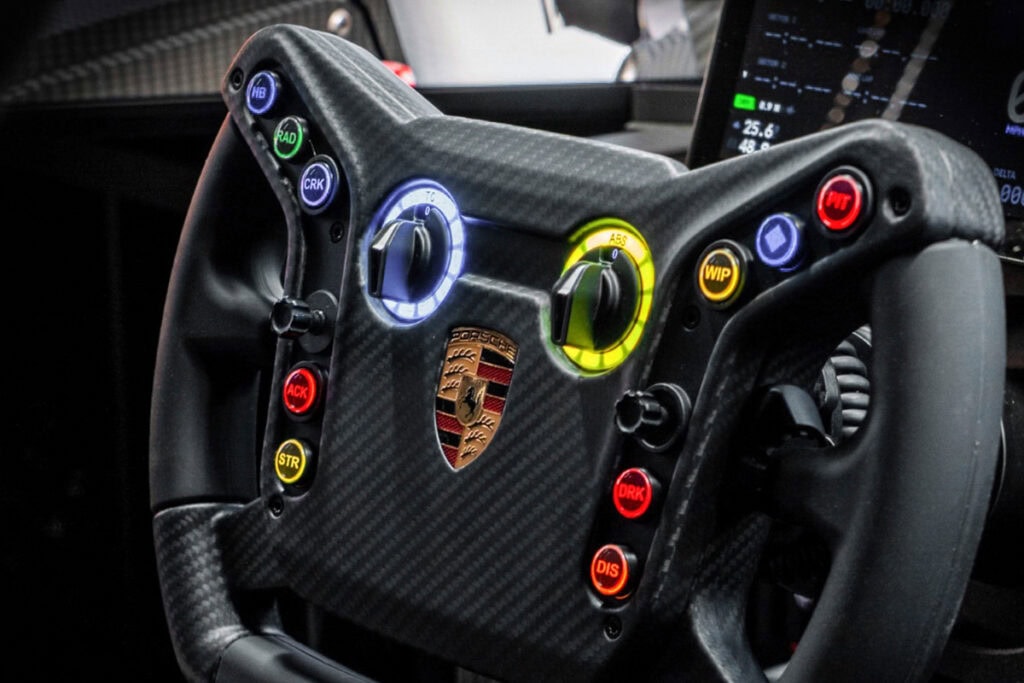
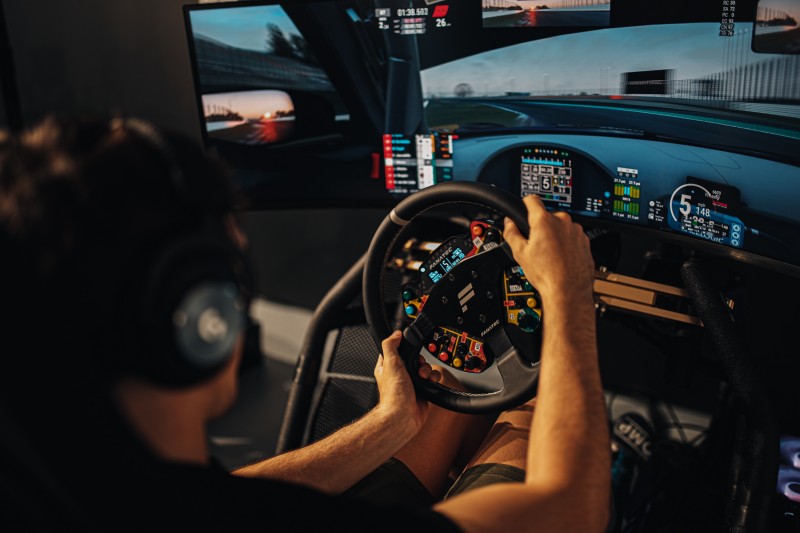
The same applies to your hands on the steering wheel. A high-quality direct drive system is not a luxury, but a communication tool. In a real car, you often feel through the “seat of your pants” (the vestibular system) when the rear starts to step out. In the rig, your hands must take over this information. You feel the reduction in resistance in the steering wheel milliseconds before you see it. Sim racers therefore train their hands as highly sensitive sensors that interpret nuances of road surface and tire wear that would completely escape a normal driver.

© SRO
Visual
In sim racing, the eye is more than just a camera lens. It is the instrument for speed perception and positioning. In a real car, peripheral vision and spatial depth help us enormously. In the simulator, we must reconstruct this three-dimensionality on (mostly) two-dimensional screens.
The training here lies in adaptation and precision of vision. An experienced sim racer does not stare at the hood. They constantly scan the horizon. Correctly setting the “Field of View” (FOV) is crucial in order to align speed perception with reality. You train your eye to precisely capture reference points — a crack in the asphalt, a shadow, a distance marker — at 280 km/h.
Since modern tracks are laser-scanned digital twins of reality, this visual training is transferable 1:1. Whoever learns in the simulator exactly where the turn-in point for Eau Rouge at Spa-Francorchamps is will know it in real life as well. The eye learns to read the track long before the car gets there.
Auditory
The sense of hearing is often underestimated in racing or reduced to the pure enjoyment of engine sound. But for a sim racer, hearing is an analytical tool. In a real GT3 car, it is loud, the wind whistles, the gearbox howls — many subtle sounds get lost. In the simulator, however, sound design is often mixed in a way that gives us critical information with crystal clarity.
You hear the “singing” of the tires long before the car actually slides. So-called “tire scrubbing” provides acoustic feedback about the limit of grip. The same applies to the rattling of ABS or slight over-revving of the engine during downshifts. A sim racer uses their ears to feel the limit. You learn to hear vehicle states. This auditory sensitivity sharpens your reaction time, as the acoustic signal is often processed faster than the visual confirmation that the car is sliding.

© Res-Tech
The cognitive level
In addition to the senses, sim racing is massive training for the brain. The cognitive load of driving a virtual vehicle at the limit consistently for 60 minutes is enormous. It is about decision-making under pressure.
Professionals use the simulator to turn conscious actions into subconscious automatisms — so-called procedural memory. If you have practiced a thousand times in the simulator how to catch a stepping-out rear in a specific corner, you no longer have to think in a real situation. You act instinctively. In this moment of concentration, the brain no longer differentiates between reality and simulation. The stress you feel while defending your position in the final lap triggers real physiological reactions.
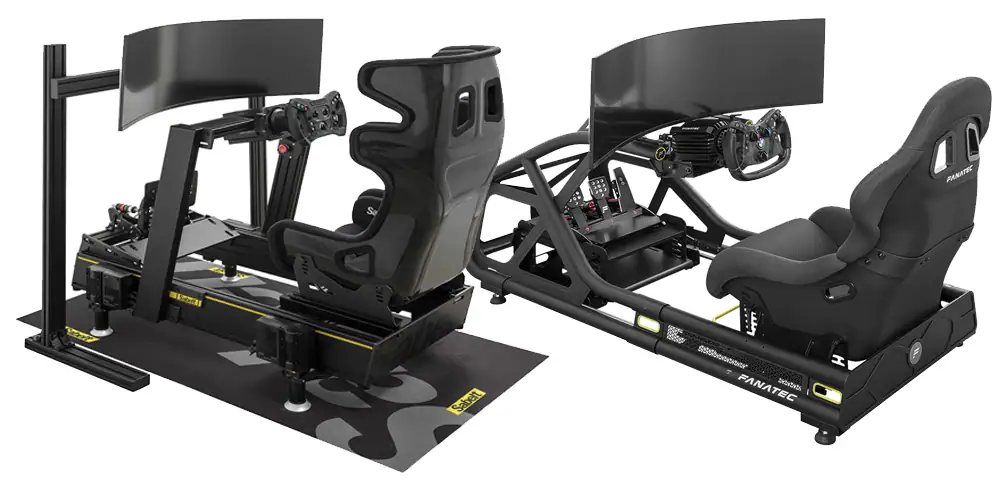
So the next time someone asks you why you invest so much time and passion into your rig, the answer is simple: You are training your senses to a level that is not required in everyday life. You compensate for missing physical forces through increased haptic, visual, and auditory precision.
You are not playing a game. You are practicing motorsport. And that is exactly why, at SimUltimate, we provide you with the necessary hardware.