Every sim racer knows this phase: at the beginning, lap times tumble down almost by themselves. With each passing week, you get faster, your iRating curve shoots upwards and your confidence grows. But then it happens – you hit an invisible wall. The so-called plateau. No matter how many laps you do, your times no longer improve. Frustration sets in.
The good news is: A plateau is completely normal. The bad news: Doing more of the same won’t help here.
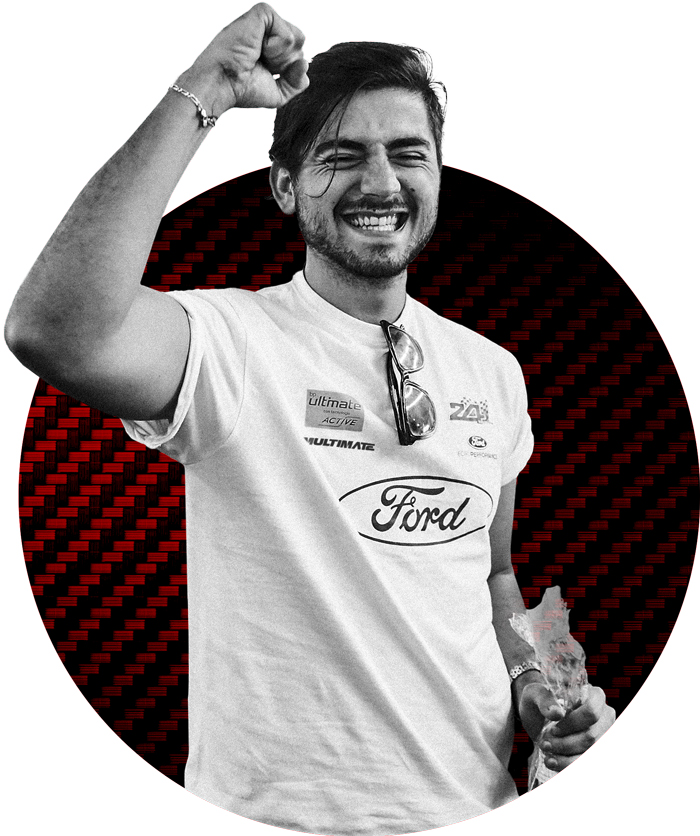
Our SimUltimate Head Coach Jesús Sicilia – former finalist of the Ferrari eSports Drivers Academy and representative of Aston Martin Racing – knows exactly where to look. From his experience in eSports and real-world motorsport, he analyzes telemetry data and driving styles on a daily basis.
Here are the 5 main reasons Jesús sees in almost every driver who stops getting faster – and what a professional coach looks at to force a breakthrough.
1. Training without system and structure
The most common mistake is mindlessly grinding laps. Many drivers get into the rig and drive in circles for hours, hoping to get faster through sheer repetition. But those who drive without a plan often just reinforce bad habits.
The coach’s perspective: Jesús doesn’t look at how much you drive, but how. Effective training requires a concrete goal for each session. Is today only about trail braking into Turn 1? Or about tire management over 20 laps? A coach checks whether telemetry is used to objectively identify weaknesses, and whether breaks are taken before concentration drops. Quality beats quantity.
2. “Overdriving”: When willpower tries to defeat physics
When lap times stagnate, many drivers try to force the time. They brake later, steer more aggressively, and get on the throttle earlier. The result is classic “overdriving.” The car slides, the tires overheat, and corner exit is sacrificed.
The coach’s perspective: Here, Jesús looks at instability in the car. Excessively late braking often destroys the balance needed for the apex. Wild steering corrections are a sign that the car is being forced to do something physics won’t allow. The coach teaches that real speed often comes from calmness, smoothness, and letting the car flow — not from aggression at the wheel.
3. Neglecting the fundamentals for setup tricks
At a certain level, sim racers tend to blame the setup. Hours are invested in damper settings while cracks appear in the driving fundamentals. Real breakthroughs rarely come from a click on the wing, but from working on the basics.
The coach’s perspective: Before talking about setup nuances, Jesús checks the foundation: Is the full track width really being used down to the last centimeter? Is brake pressure consistent, or are there nervous spikes? Are steering inputs smooth? If the fundamentals aren’t mastered 100 percent, even the perfect setup won’t make you faster.
4. Racing as a pure stress test
Many drivers stagnate because they treat every official race as a test of their pace. The fear of losing iRating leads to tense driving. You drive not to lose, instead of driving to learn.
The coach’s perspective: A coach encourages using races as an experimental field. Jesús doesn’t just analyze the final position, but behavior in traffic. Was the tire management practiced in training executed under pressure? A mistake is not a failure, but a data point. Those who learn to work on specific skills (like patience or defensive line choice) during races will become more consistent and faster in the long run than a pure “hotlapper.”
5. The blind spot: Lack of objective feedback
Perhaps the most important reason for a plateau is tunnel vision. As a driver, it’s extremely difficult to recognize your own mistakes because they feel “right” in the cockpit. You can’t correct what you don’t perceive.
The coach’s perspective: That’s the superpower of an external expert. A coach like Jesús immediately recognizes patterns that have escaped the driver for months — whether it’s incorrect vision technique or a systematic mistake during load transfer. Once that blind spot is exposed, the plateau often disappears into thin air.

Do you want to break through the wall?
There is no shame in being stuck on a plateau. But it is unnecessary to stay there.
Jesús Sicilia brings not only experience from the highest eSports leagues, but also an understanding of real racing physics. He knows how to read data and teach driving technique that truly makes you faster.
Stop guessing and start training with purpose. Book your personal 1‑on‑1 coaching now